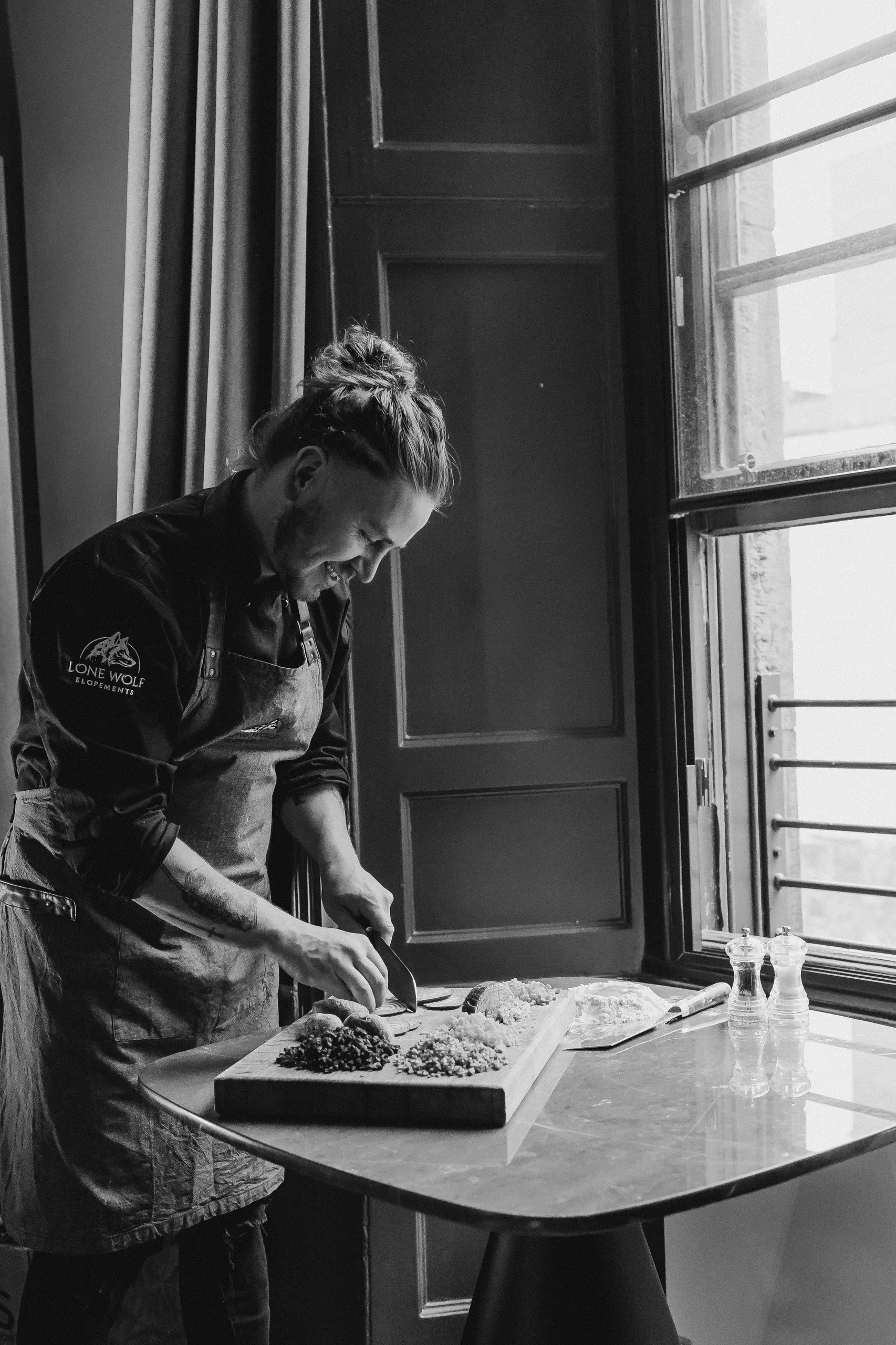
Joe will be creating a special storytelling menu for the Sunday evening of our February Reading Retreat, inspired by the season and landscape of The Lake District.
Tell us a bit about yourself.
I’m 34 and have spent the last 20 years working in professional kitchens, building my experience across a range of restaurants, hotels and hospitality settings. Cooking has always been about more than simply preparing good food for me; it’s a combination of technical skill, creativity, curiosity and the desire to give people something memorable.
Outside the kitchen, you’ll usually find me getting lost in another world, whether that’s Westeros, Middle-earth or jumping in the camper-van and heading somewhere in the Scottish Highlands, exploring with my wife, Lo, and our Pomeranian, Alfie. I’ve always been drawn to stories, history and the details that make a place or an experience feel special, and those interests are constantly inspiring my menus.
What is a storytelling menu?
A storytelling menu is a bespoke dining experience that brings together food, imagination and narrative. It combines my experience as a chef with the creative side of my brain, using ingredients, flavours, textures and presentation to connect each course to a wider story.
Rather than simply choosing dishes that work well together, each course has its own purpose, with individual elements representing particular memories, places, people or ideas. As the meal progresses, those elements begin to connect, taking guests on a journey that unfolds through the food itself.
The aim is to create something that tastes incredible but also gives people something to think about, talk about and connect with. Every menu is different because every story is different, making the experience personal to the people around the table.
What does the Lake District mean to you as a chef?
The Lake District has been my professional playground for the past 20 years. It’s where I’ve developed my skills, worked alongside some fantastic chefs and had the opportunity to cook in some wonderful hotels and restaurants.
One of the things I’ve always appreciated about working here is the balance between welcoming returning guests and meeting people visiting the area for the first time. You learn that food needs to mean something to people, whether it’s offering a sense of familiarity after a long day exploring the fells or introducing them to a flavour combination they’ve never experienced before.
The landscape is also a constant source of inspiration. There’s a real connection between the food, the seasons and the environment here, and I think that gives a chef plenty to work with. The Lake District has played a significant role in shaping the chef I am today, both professionally and creatively.
When you think about the Lake District in February, what comes to mind?
For me, February sits in that fascinating transition between late winter and the first hints of spring. There’s still a real bite in the air, but the days begin to stretch out, the light changes and you start to notice the landscape slowly waking up again.
It’s one of my favourite times to explore the Lakes. You can have a cold wind cutting across the fells under a brilliant blue sky, with a completely different atmosphere from the darker, heavier days of midwinter.
I like that contrast, and it’s something I want to reflect in the food. There’s still a need for warmth, depth and comfort, but there’s also room for freshness, brightness and a little more energy. It’s about capturing that moment when winter hasn’t quite let go, but spring is beginning to make itself known.
Are there particular ingredients, flavours, colours or textures that make you think of this landscape in February?
I’m drawn to ingredients that reflect that transition between the seasons. You still want the warmth and substance of winter cooking, but you can begin introducing brighter greens, fresher flavours and lighter textures to bring a dish to life.
Root vegetables are brilliant for this. Something like parsnip, with its natural sweetness, can take on a completely different character when paired with warming ginger. Combine that with a walnut and kale salad, and you have a dish that still feels comforting but has freshness, contrast and a little more lift.
I’m also slightly obsessed with beetroot. Its colour alone is incredible, but it’s the versatility that really interests me. Earthy, sweet, vibrant and capable of working across so many different flavour profiles, it can bring depth to a dish while adding a striking visual element.
For me, it’s about balancing those elements: earthy against bright, rich against fresh, and soft against crisp. The food should feel appropriate for the season and the landscape without becoming heavy or predictable.
What do you hope people take away from the meal, beyond the food itself?
One of the main reasons I started The Lone Wolf Chef was that I wanted to create a dining experience that felt genuinely different from anything I’d come across before.
I love watching people interact around a dinner table: conversations developing, people sharing opinions about a dish, stories emerging and connections forming between guests. Food has a remarkable ability to bring people together, and a storytelling menu gives those conversations another layer to build on.
Whether guests arrive surrounded by their closest friends or sitting alongside people they’ve never met before, I want the atmosphere to feel intimate, relaxed and familiar, while still offering a sense of adventure. There’s something special about being encouraged to try something new in an environment where you feel comfortable doing so.
Ultimately, I hope people leave with more than memories of a good meal. I want them to have shared an experience that brought them closer together, sparked conversation and stayed with them long after the final course.
Is there a place in the Lake District that is particularly important to you, and why?
For me, it would have to be Coniston. There are so many walks and places to explore around that area, whether it’s heading towards Tilberthwaite, exploring the old copper mines or taking a quieter wander around Tarn Hows. It’s a landscape I keep coming back to, and one that never seems to lose its appeal.
Coniston is also significant to me professionally. It was where my head chef career really took an exciting turn, and I had a view of the Old Man of Coniston from my kitchen window. Having that landscape in front of me every day had a real influence on my creativity.
There’s something about being surrounded by that scale of landscape that encourages you to think differently. It gives you perspective, space to experiment and the freedom to let ideas develop. Looking back, it was an important chapter in my career, and Coniston remains a place that holds a lot of personal and professional meaning for me.
What is a book that has had an impact on you, or stayed with you?
Rather than a single book, I’d choose Ken Follett’s Century Trilogy. Across three novels, it follows a collection of fictional characters and their families through the First World War, the Second World War and the Cold War, placing their personal lives within the context of major historical events.
I’ve always been fascinated by history, and what I particularly enjoyed about the trilogy was the way it explored these periods through people from very different backgrounds. From Russian peasants to British aristocrats, the characters experience the same broad historical events in completely different ways, depending on their circumstances, relationships and place in the world.
It gave me an engaging way to explore what life might have felt like for people living through those periods, rather than simply learning the dates and facts. It highlights how personal experiences, individual perspectives and the wider world all intertwine to shape a story.
Find out more about The Lone Wolf Chef